Monday, May 18, 2009
Sin Fortuna - Leonardo Chacón Campeonato Panamericano de Triatlón 2009 Oklahoma City
Oklahoma, USA. El equipo CRC Endurance no tuvo la suerte de su lado el pasado sábado 16 de mayo en el Campeonato Panamericano disputado en Oklahoma City pues Leonardo Chacón pinchó su llanta en el kilómetro 25 y no pudo terminar.
Leo había hecho una natación impecable y había salido con el grupo puntero hacia la transición de la bicicleta. En el ciclismo los norteamericanos atacaron muy temprano dejando rezagados a todos menos a Leo y el canadiense Andrew McCartney.
Así las cosas muy temprano el triatlón prácticamente estaba en manos de 7 hombres, cinco norteamericanos, Leo y McCartney . Pero la mala fortuna llegó a poco mas de la mitad del ciclismo cuando su llanta trasera pinchó y ahí se acabaron las aspiraciones al podium que tenía Costa Rica.
"Es una lastima porque Leo iba entero, había respondido a los ataques de los estadounidenses y después de ver los tiempos de los dos primeros Reed y Kemper sabiamos perectamente que Leo podia correr igual que ellos, los tiempos del tercero para atras son regulares". Comento Roberto Solano desde Oklahoma.
La reacción de Leo fue al inicio de tristeza, sin embargo en un par de horas volvió a entrenar con todas las ganas para confirmar su nivel en Madrid el próximo 31 de mayo en la segunda fecha del Super Series, donde se darán cita los mejores 55 triatletas del orbe.
Pero las malas noticias no terminan aquí pues el sub-23 Roger Rodríguez realizaba una estupenda competencia e iba disputando la primera posición hasta que su llanta delantera cayó en un hueco lo que provocó la caída del corredor y la fractura de su clavícula.
Roger es el talento con mayor potencial del país a su edad, su gran carisma, disciplina y carácter harán que vuelva pronto a su gran pasión, el triatlón.Este estudiante de ingeniería mecánica de la Universidad de Costa Rica se enfocará en sus estudios para retomar entrenamientos en un mes.
En otros resultados los junior sufrieron con el frío del agua pues no los dejaron competir con wetsuit y eso les afecto muchísimo su rendimiento en la bicicleta.
Gabriel Zumbado finalizó 38, Berny Roldan 40 y Rafael Chacón 50.
En elite masculino Rom Akerson resintió el frío y una vieja lesión en su pierna, finalizó 30.
Alia Cardinale, elite femenino tuvo de igual manera problemas con el frío apesar de que salió con el grupo puntero de la natación pero los calambres minaron su rendimiento en la bicicleta y la carrera.
Tuesday, May 12, 2009
Siete triatletas ticos al Panamericano

Leonardo Chacón será la carta criolla más importante en torneo continental
La delegación de Costa Rica estará integrada por una mujer y seis hombres
José Luis Rodríguez C. jorodriguez@nacion.com
Una delegación de siete costarricenses competirá este sábado en el Campeonato Panamericano de Triatlón que se llevará a cabo en Oklahoma, Estados Unidos.
Rafael Chacón, Berny Roldán, Gabriel Zumbado, Róger Rodríguez, Alia Cardinale, Rom Akerson y Leonardo Chacón son los integrantes del equipo que partirá mañana a las 10 a. m.
Entre los nombres destaca el de Leonardo Chacón, quien se perfila como la carta más fuerte.
De acuerdo con Roberto Solano, entrenador de Chacón, este año se presenta la particularidad de que la competencia es en Estados Unidos, y ello hace que la prueba sea mucho más exigente.
Solano añadió que para tratar de combatir la fortaleza de los locales, aparte de lo que presentarán Canadá, México, Argentina y Brasil, entre otros, Chacón tendrá la ayuda de Rom Akerson, también de la categoría élite, y de Roger Rodríguez, quien va en la Sub-23.
Mientras que Chacón y Akerson irán en clase élite, Rodríguez lo hará en Sub-23, Alia Cardinale en élite mujeres, y Rafael Chacón –hermano de Leo–, Gabriel Zumbado y Berny Roldán en junior
Monday, May 4, 2009
My triatlons so far
Too see my event schedule for 2009 click HERE
Triatlón Internacional Bahía Papagayo - El Coco 2009 - April 2009 (1.6K – 60K – 16K) Swim = 37:20; T1 = 4:20; Bike = 2:14:40; T2 = 2:24; Run = 2:01:26; Total Time = 5:00:10 LESSON LEARNED -- gotta take transitions more seriously!!
COPA DE TRIATLON JACÓ 09 - 29 March 2009 (1.5K – 40K – 10K) approximate times... Swim 31:17:00 Bike 1:20:57 [left T1 with running shoes on, had to go back for biking shoes - ha ha + spider bite in tigh - spider must have fallen from a tree - nothing serious, did hurt and scare me though!] Run 1:07:11 Total 3:05:08½ TICOMAN - 29 Nov 2008 (2K – 90K – 21K) Swim 0:46:46 Bike 3:56:44 [3 flat tires] Run 2:23:25 Total 7:06:55
TRIATLÓN CROSS – PUNTA COCLES 2008 - 14 Sept 2008 (0,75 K – 27K – 6K) Swim 00:29:40 [Mauricio] Bike 01:30:45 [Mauricio] Run 01:12:51 [Carlos] Total 3:13:16
TRIATLON CROSS POZO AZUL - 27 Jul 2008 (1.5K - 30K - 10K) Swim 0:48:21 -- T1 0:12:40 [Mauricio] [T1 –K run] Bike 2:46:59 -- [Ricardo] - [w/ 2 flat tires] Run 1:04:17 – [Carlos] Total 4:52:17
XTERRA TAMBOR COSTA RICA 2007 - 08 Sept 2007 (1,5 KM. - 32 KM. - 10 KM.) Swim 0:39:45 --T1 0:04:39 Bike 3:05:03 --T2 0:02:22 Run 1:40:57 Total 5:25:45
XTERRA CARIBE 2007 -14 de Jul 2007 (0,75 KM. - 40 KM. - 10 KM.) Swim 00:15:20 Bike 01:47:36 Run 01:00:56 Total 03:03:52
Wednesday, April 22, 2009
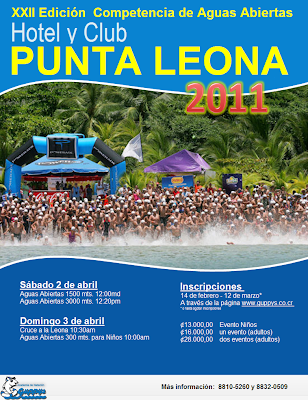
Aguas abiertas - Punta Leona 2009
3.000 metros Punta Leona se realizará este sábado con 800 nadadores
De diez años en que ha participado, Niehaus ha ganado todas las veces
Luis Edo. Díaz luisdiaz@nacion.com
Kurt Niehaus buscará este sábado [25 de abril de 2009] su undécimo título en la competencia de aguas abiertas conocida como los 3.000 metros Punta Leona, en Puntarenas.
El nadador se presenta como la figura a vencer en Playa Mantas, en la más longeva y popular competencia de aguas abiertas del país y en la que este año se darán cita 800 nadadores.
Los 3.000 metros Punta Leona llega este año a su edición 20; de las 19 versiones anteriores, diez las ganó Niehaus.
“Por sí sola es una competencia fuerte, pero si a eso le sumamos que siempre llegan los mejores nadadores de resistencia del país, el título se vuelve más disputado y revalidarlo no será algo sencillo”, comentó Niehaus, quien comenzó a competir en este deporte hace 14 años.
Ricardo Prada, organizador y creador de la prueba, comentó que ya están cerradas las inscripciones; además, se esperan buenas condiciones en el tiempo y en las corrientes marinas del Pacífico punterenense.
Detalles. La prueba del fin de semana iniciará el sábado a las 12 mediodía con la competencia de 1.500 metros; varios minutos después tomarán partida los nadadores de los 3.000 metros.
Ambas modalidades tendrán que recorrer un circuito en forma triangular de una longitud de 1.500 metros, lo que significa que quienes compitan en 3.000 metros harán dos vueltas completas.
Las actividades culminarán el domingo con dos eventos: las pruebas para niños y el llamado ‘Cruce a la Leona”, que consiste en una competencia de 2.200 metros de aguas abiertas entre las playas Mantas y Blanca.
El organizador Prada comentó que para esta edición el nadador más joven es un escolar de ocho años, y el de más edad es un adulto mayor de 74 años
Monday, April 20, 2009
Revistas de Triatlón - Triathlon Magazines
Colorado Triathlete Features stories, race coverage, calendars, results, photos, and coaching information concerning Colorado triathletes.
Duathlon.com Provides regular triathlon and duathlon news from around the world.
Extreme Tri Online magazine for long-distance triathlon. Features race reports, news, calendars and athlete information.
Inside Triathlon Magazine provides the latest triathlon and multi-sport news as well as in-depth race coverage and training advice.
Runner Triathlete News Magazine for runners, triathletes, and cyclists in the Southwestern states of Arkansas, Louisiana, New Mexico, Oklahoma, and Texas.
Slowtwitch.com Online triathlon magazine with product reviews, a bike fit guide, training tips, and several regular columnists.
Transition Times Endurance sports community and place to share videos, audio, photos, and stories.
Tri-Newbies Online Features news, nutrition, training programs, physical therapy, and more.
Triathlete Magazine Tracks and details the updates in the triathlon world and gives summaries on leaders in the sport, tips on clothing apparel, attitude notes, more.
Triathlon Week Covers triathlon, cycling, running, swimming, and includes event listings, recent news, and discussion forums.
Trifuel Triathlon training and gear reviews resource. Training programs and articles for multisport and endurance training, plus race listings and forums.
Thursday, April 16, 2009
Triatlón Internacional El Coco 2009
La Federación Unida de Triatlón y Global Sportx Group (www.gsxg.net) tienen el agrado de invitar a todos los atletas interesados al evento más tradicional de la disciplina del Triatlón en Costa Rica, la edición 2009 del Triatlón Internacional del El Coco, a realizarse el próximo 2 de mayo a partir de las 6:30 am en playa Panamá, Guanacaste.La inscripción ordinaria al evento se realizará por medio de la página de internet http://www.gsxg.net/ o en las tiendas Runners Pavas, Curridabat y Heredia. También pude dirigirse directamente a Global Sportx Group (puede cancelar con tarjeta), (Plaza Rohrmoser planta subterránea Oficina S3) únicamente del martes 14 de abril al sábado 25 (tarifa regular) y extraordinaria del 26 al 30 de abril (se cobrará un recargo del 50%).
Monday, April 13, 2009
Leo Chacón apunta al Panamericano

El próximo 17 de mayo, en Oklahoma, competirá en dicha prueba continental
Su patrocinador, DHL, le aseguró que irá al Copa del Mundo de Madrid
José Luis Rodríguez C. jorodriguez@nacion.com
25 días de intensa preparación en varios lugares de Cartago representan el último paso de Leonardo Chacón, previo al Campeonato Panamericano de Triatlón que se efectuará el domingo 17 de mayo en Oklahoma, Estados Unidos.
Los 25 días comenzaron ayer, y fueron programados por Roberto Solano, entrenador de Chacón.
Solano posee un centro de entrenamiento de altura en Llano Grande de Cartago, donde Leo Chacón pasará las noches.
“Duermo en Llano Grande –ubicado a unos 2.200 metros sobre el nivel del mar–, pero entreno en Cartago o en Lomas de Ayarco, el principio es vivir arriba y entrenar abajo”, manifestó Chacón.
Entre las ventajas que da el vivir en zonas altas y entrenar a menor altura, está el que se aumenta la cantidad de masa de glóbulos rojos, y con ello el atleta tiene mayor capacidad de amortiguamiento de los iones de hidrógeno, lo que quiere decir que hay menor fatiga por ácido láctico.
También se aumenta la capacidad de transporte del oxígeno que puede llegar al músculo.
Según el triatlonista, el objetivo suyo y de Solano, es arribar lo mejor preparado al Panamericano, “pues es la competencia más importante del continente”.
“Voy a enfrentar a los equipos de Estados Unidos, Brasil y Canadá, que son bastante difíciles”.
Esta será la tercera competencia internacional de Chacón en lo que va de la temporada, ya que el 8 de febrero estuvo en la Copa Panamericana de Triatlón, en Guayaquil, Ecuador, y el 29 de marzo compitió en la Copa del Mundo de Mooloolaba, en Australia.
En Ecuador finalizó de sexto y en Australia terminó de 18.
Gracias a la buena actuación en ambas, hoy el costarricense se coloca en la posición 25 del ranquin mundial que publica la Federación Internacional de Triatlón (ITU).
Dicho listado varía cada ocho días debido a que cada fin de semana hay competencias en todo el mundo, y ello hace que los competidores deban asistir a la mayor cantidad de pruebas para subir.
“Gracias a que estoy entre los primeros 25 puedo competir en la Super Serie –torneo de mayor nivel de la ITU–; mi primera competencia, que es la segunda jornada de la Super Serie, será el 27 de mayo en Madrid”, manifestó.
“Mi patrocinador, DHL, me indicó que todo está listo para ir a Oklahoma y Madrid, y a eso es a lo que estamos apuntándole”.
Chacón manifestó que existe la posibilidad de competir en la primera fecha de la Super Serie, el 2 de mayo en Corea del Sur, “mas eso lo define Roberto (Solano)”.
Con respecto al entrenamiento que efectúa en suelo brumoso, Leo Chacón explicó que ayer, en su primer día, hizo 115 kilómetros de bicicleta en la zona de Cachí.
“La carrera la hago en el Tecnológico y la natación en las piscinas de Lomas de Ayarco”.
Monday, March 30, 2009
Summary of Triathlons I´ve participated in so far
Too see my event schedule for 2009 click HERE
COPA DE TRIATLON JACÓ 09 - 29 March 2009 (1.5K – 40K – 10K) approximate times... Swim 31:17:00 Bike 1:20:57 [left T1 with running shoes on, had to go back for biking shoes - ha ha + spider bite in tigh - spider must have fallen from a tree - nothing serious, did hurt and scare me though!] Run 1:07:11 Total 3:05:08
½ TICOMAN - 29 Nov 2008 (2K – 90K – 21K) Swim 0:46:46 Bike 3:56:44 [3 flat tires] Run 2:23:25 Total 7:06:55
TRIATLÓN CROSS – PUNTA COCLES 2008 - 14 Sept 2008 (0,75 K – 27K – 6K) Swim 00:29:40 [Mauricio] Bike 01:30:45 [Mauricio] Run 01:12:51 [Carlos] Total 3:13:16
TRIATLON CROSS POZO AZUL - 27 Jul 2008 (1.5K - 30K - 10K) Swim 0:48:21 -- T1 0:12:40 [Mauricio] [T1 –K run] Bike 2:46:59 -- [Ricardo] - [w/ 2 flat tires] Run 1:04:17 – [Carlos] Total 4:52:17
XTERRA TAMBOR COSTA RICA 2007 - 08 Sept 2007 (1,5 KM. - 32 KM. - 10 KM.) Swim 0:39:45 --T1 0:04:39 Bike 3:05:03 --T2 0:02:22 Run 1:40:57 Total 5:25:45
XTERRA CARIBE 2007 -14 de Jul 2007 (0,75 KM. - 40 KM. - 10 KM.) Swim 00:15:20 Bike 01:47:36 Run 01:00:56 Total 03:03:52
Copa Mundial -- Leo Chacón quedó de 18 en Australia
El triatlonista costarricense Leonardo Chacón ocupó la posición 18 en la Copa Mundial de Triatlón celebrada este fin de semana en la playa de Mooloolaba, Australia.
Chacón hizo una marca de 1 hora, 56 minutos y 34 segundos tras nadar 1.500 metros, cumplir una prueba de ciclismo de 40 kilómetros y correr otros 10 kilómetros.
El ganador del evento fue el australiano Courtney Atkinson con un registro de 1:52:05.
Roberto Solano, entrenador de Chacón, calificó este resultado como “muy positivo”.
“Es la mejor posición lograda en Australia por Leo y él está muy contento, pues hizo los puntos necesarios y con ello logró clasificarse a un torneo que se realizará en mayo en Corea (del Sur)”, dijo Solano.
Precisamente, esa será la próxima competencia internacional que tendrá del triatlonista tico.
El técnico indicó que Chacón perdió 15 segundos tras realizar la prueba de natación, pues fue penalizado por un juez porque supuestamente no completó una boya.
“Él salió con el primer grupo del agua, pero por esa penalización los perdió, sin embargo, recuperó bastante al realizar la prueba de atletismo. Espero que con este resultado amanezca entre los primeros 20 del escalafón mundial”, indicó.
Otros ticos. Leonardo Chacón no fue el único costarricense destacado este fin de semana en una prueba de triatlón internacional.
Roberto Solano informó de que Rom Akerson y Róger Rodríguez obtuvieron buenos resultados durante un torneo celebrado en Perú.
En el caso de Akerson, finalizó en la cuarta posición.
“De esta forma se consolida como uno de los mejores de América”, aseguró Solano.
Por su parte, Rodríguez concluyó en el puesto 11 en Perú. “Ya Leo no está solo, ahora podemos hablar de un equipo”, indicó Solano.
Friday, March 27, 2009
COPA de Triatlón 09 - Jaco, Costa Rica

More Information Here
Tuesday, March 24, 2009
CRC Endurance - Leo´s New Team

Tuesday, March 17, 2009
Leo Chacón mantiene beca internacional

La Federación Internacional de Triatlón lo ayudará en copas mundiales
Su primera prueba será el 29 de marzo en Australia pero aún no le renuevan la visa
Por tercer año consecutivo el costarricense Leonardo Chacón recibirá una beca por parte de la Federación Internacional de Triatlón (ITU, por sus siglas en inglés), para competir en Copas Mundiales.
La información fue dada ayer por Chacón, quien manifestó que la beca cubre su ida a tres Copas del Mundo, aparte de que le da la posibilidad de entrenarse en Europa a mediados de año.
“Esta beca es para triatlonistas que son vistos por la ITU como buenas promesas de cara a las próximas olimpiadas de Londres, en el 2012”, expresó ayer Chacón.
El triatlonista ya había disfrutado de dicho beneficio en el 2007 y 2008, con el fin de que llegara bien preparado a las olimpiadas de Pekín, China, realizadas en setiembre anterior. El criollo no logró clasificarse a estas justas.
De acuerdo con el triatleta, aunque no estuvo en Pekín, la federación internacional tomó en cuenta la quinta posición que tuvo el pasado 27 de octubre en la Copa Mundial de Huatulco, México.
“Ellos valoraron que no fui a Pekín porque el año pasado tuve un accidente y mucha mala suerte, aparte de que consideraron lo que hice en México”, expresó Chacón.
El quinto lugar en la Copa del Mundo de Huatulco es la mejor posición que ha conseguido un triatlonista tico en toda la historia.
Ante la alegría que representa la beca, Chacón está preocupado porque aún no recibe la visa australiana que le permitirá competir el próximo 29 de marzo en la Copa del Mundo de Mooloolaba, Australia.
“Hace un mes envíe todos los papeles a México, ya que allá emiten la visa para ir a Australia, pero aún no me han devuelto el pasaporte, me preocupa porque el próximo domingo tengo que partir hacia Mooloolaba”, añadió.
Los gastos en los que el costarricense incurra en Australia serán cubiertos por la ITU como parte de la mencionada beca.
“La ITU se encarga del apoyo mecánico, entrenadores, soporte, alimentación y hospedaje, además, si me voy a entrenar a Europa la federación me consigue un equipo para no entrenar solo”, agregó Leo .
La idea de Chacón y su director técnico, Roberto Solano, es realizar una estadía de dos meses en tierras del Viejo Continente, aunque esto no se ha definido.
Ritmo intenso. De cara a la temporada 2009, que incluye su participación en las siete jornadas de la Super Serie –torneo de mayor nivel que tiene la ITU–, Chacón enfrenta una fuerte preparación.
Su jornada semanal es de 18 horas, en la que se incluyen sesiones de bici , natación y carrera.
“En natación hago entre 17.000 y 22.000 metros semanales, 300 kilómetros de ciclismo y 60 ó 65 kilómetros de atletismo”, explicó.
“Mi meta es hacer el mejor papel en la Super Serie”, dijo Leo , quien está 23 en la ITU .
Tuesday, March 10, 2009
Leo Chacon fue sexto - Copa Panamericana de Triatlón en Ecuador
El triatlonista costarricense Leonardo Chacón ocupó el sexto lugar en la tercera fecha de la Copa Panamericana de Triatlón celebrada en la localidad de Playas, Guayaquil, Ecuador, según la información suministrada por su equipo, CRC Endurance.
Desde la natación, Chacón logró colocarse en un grupo puntero de diez hombres donde destacaban japoneses, estadounidenses y brasileños. Mantuvo esa posición en los kilómetros de bicicleta y corrió con los punteros.
Por su parte, el también costarricense Rom Akerson finalizó de décimo. El ganador de la prueba fue el estadounidense Kevin Collington.

Monday, February 16, 2009
Duathlon - Copa Desafio de Asfalto 2009
I was happy with the results!!!

Wednesday, January 28, 2009
Back into regular training
Ehhhhhh
Wednesday, January 21, 2009
Triathlon Quote of the Day
Heart Rate Monitor Training for Triathletes Part II
Becoming a Better Animal: How to Effectively Use Your Heart Rate Monitor.
Welcome back! Hopefully the information from Part I was a good overview of the possibilities and limitations of using your heart rate monitor (HRM) and I also hope you had a good sweat while collecting those maximums for cycling and running. Here in Part II, we’ll put those numbers to use by presenting a couple options to use your HRM in workouts.
Many a manly man can tell by looking (while grunting) at their garage walls that no single tool is ever a complete solution, and your HRM is no exception. Now that you’ve dropped a thousand drachmas on your new monitor to help tell you everything your ticker is doing during your bike ride, I’m here to tell you that there’s an even more overall effective and low-rent tool available—your own body.
While you may not be able to pinpoint your exact heart rate at any given time during a workout without using a monitor, knowing those triple digits is not the goal of your training sessions and races—it’s your overall intensity that’s important. On Race Day, intensity correlates to speed over distance, which correlates to a finishing time. Training sessions also have a goal of time and/or distance and intensity. So far, no Olympic medals are given to the athlete who crosses the line with the lowest heart rate.
Planning workouts around these percentages is quite easy to apply. Let’s put a name to some common workout ranges and then assign values:
Steady State: many training publications lately are recommending to not spend much time in this zone. It has been recommended to either drop back to the easier zones or move up. In the past I haven’t tried to avoid this area, so I can’t yet advise to follow this information. My personal training in the next year is aimed at experimenting with this to find out.
Dr. Borg devised scales to capture things like pain, taste, brightness, noise, and even moods. You have probably already seen one of his scales hanging up at the gym—the Rating of Perceived Exertion (RPE). The RPE scale was intended to subjectively put a concrete value to the amount of workload people experienced during physical exertion.
Below in Chart 2 is Borg’s Modified RPE chart showing exertion rates. The chart is numbered from 0 to 10 (with a peak category called “*” or off the chart). Borg wrote simple descriptions for each level ranging from complete rest at 0 to maximal possible exertion at “*”
Applying The Heart Rate Numbers--Your Personal RPE Chart
To fill in the chart, you’ll see that 0 indicates total rest—here you can enter your resting heart rate (RHR). At level “*” (or off the chart), enter your cycling and running maximum heart rates (MHR). In addition to Borg’s descriptions, I’ve added some more that should help.
Now comes the hard part—filling in the middle of the chart. The easiest way to do this is practice. Wear your monitor on bike rides and runs of all different intensities and get a feel for how hard you’re working and try to make an honest assessment placing an level number to that effort. While it would be much easier to calculate a fixed number but the values wouldn’t be accurate. Also, most of the values for expending effort take up most of the range of the chart so drawing a line between resting and maximal will not give accurate numbers.(2) The reason is that there are only a couple levels to describe everything from complete rest to fast walking is that most of us don’t have much of an interest in distinguishing effort levels from just watching TV to dialing the pizza guy while watching TV (although I’m sure the calorie burning does add up after enough dialing.)
So why isn’t there a formula to fill in the chart and why use it instead of the simple chart from Part I? Matching effort level to heart rate is very closely linked to your fitness level at a specific time in each sport . For example, in January, running at what feels like a moderate pace (Level 3) might show as 150. In June, that same moderate feeling run may only show as 140 due to many factors such as increased fitness and warmer temperatures, or even negative factors such as overtraining or illness. If you had stuck to running January’s 150 level for your run, you’d be going too hard for your moderately scheduled workout.
A good way to practice using the chart is to spend some workout time playing a game of Heart Rate Jeopardy: “I am working fairly strong.”….”What is 155?” It sounds cheesy (and it is) but you’ll be surprised after a few weeks of how close you can come to the actual reading. Also take your HRM to races and see how good you are at guessing. Race stress and increased pace from your normal training sessions might keep you out of the Final Jeopardy round for a while until you become more tuned in to your body, but practice, practice, practice. A final note about race heart rates…you might not be able to use your normal training values on race day due to increased stress and adrenalin. Using your training rates in a race situation can leave you going at a lower pace than your body is capable of for a given intensity due to “race stress.” Again, know your own body—if you don’t feel any stress and it feels like a calm day on the course you can trust the monitor a little more than if you’ve got cyclists zooming all around you with friends and family cheering roadside.
Chart 4: Compact RPE/Heart Rate Chart
(print one each for the bike and run)
Myth: The Fat Burning Range
It is true that while performing aerobic exercise that at the lower end of the aerobic zone (about Level 3 on the Modified RPE chart) that the body does burn a higher percentage of fat than carbohydrate and that at higher intensities (Level 8) the body burns a higher percentage of carbohydrate than fat as fuel.(3)
Notice that I said percentages and not total calories. A Level 8 workout for 30 minutes is going to burn far more calories than at Level 3. Let’s look at an example of a 150lb person running at Level 3 (ex: 12min pace) and also running at Level 8 (7.5min pace):
Level 3 run for 30 minutes: burn 55% fat, 45% carbohydrate, 288 total calories
Level 8 run for 30 minutes: burn 10% fat, 90% carbohydrate, 460 total calories
Even though the Level 8 workout may have burned less overall calories from fat, the overall number of calories is much higher. More total calories burned = Smaller Jeans.
Final Note: Cardiac Drift
Now that you have a good overview of RPE and using your monitor in workouts, I’d like to another point that can cause some discrepancies between effort level and heart rate. During long workouts of usually more than 1 hour, the heart has a tendency to beat slightly faster even though you do not feel as if you are working any harder—this is called cardiac drift, or cardiac creep. The heart rate increases even for the same effort expended because as you sweat, your blood volume decreases due to fluid loss and also your heart tries to do its part in regulating body temperature. The good thing for you is that in most cases you might not need to slow down as the heart rate creeps up. As long as your major muscle groups aren’t being affected and you don’t feel more laboured, there’s no reason to strictly obey your HRM. Common sense should prevail in extreme conditions of heat, cold and dehydration though. If you’re training or racing and your HRM is showing elevated (or depressed in the case of cold temps) values, do a self assessment to see if you really should follow the numbers or if common sense tells you to slow down. Again, the point of this entire article is to show that the HRM is a useful tool, but that it doesn’t tell you everything you need to know.
Thanks for reading and feel free to drop me a mail if you have questions or have had some interesting results using your monitor.
Heart Rate Monitor Training for Triathletes Part I
So you’ve just finished running 40 blissful minutes. Still dripping sweat, you slog through the house towards the den while removing your brand new heart rate monitor chest strap. After downloading the workout data to your PC, you find out that you averaged 155 beats a minute. You then print out a pretty 4-color graph capturing each beat of your trail escapade to hang proudly on the fridge, edging out space from your first-grade daughter’s 64-color masterpieces. Your new toy has performed flawlessly, you now know what your heart did minute by minute, and your spouse has visual proof that it does indeed do everything the brochure said, thus justifying your lobbying efforts. Now what?
Hopefully your heart rate monitor purchase was intended for improving your athletic performance and not solely to compete with a five year old’s Louvre ambitions. In a 2-part series, I’ll cover how to use a heart rate monitor to help you train and race more effectively, what information it can’t tell you, and some common myths about heart rate-based training.
Here in Part I, I'll explain how to determine training zones with a heart rate monitor and show how using the monitor is unique to your own physiology and sports you compete in. After we setup training zones, Part II will explain how to put this information to use in training and racing, and also explain some pitfalls and cautions in using the monitor.
To use the monitor effectively, you need to know how hard your heart is working relative to your body’s capacity for the activity you are doing. Some training days are going to be easy, others will be harder efforts, and the monitor can help you stay within range of effort for a particular workout.
The single best outcome from using your heart rate monitor is to ensure your easy days are easy and your hard days are hard. This sounds almost too simplistic to even mention, but habits dominate almost every aspect of our lives, including being an athlete. “Just going out for a ride” tends to result, by sheer habit, in cycling at nearly the same effort whether it’s 60 minutes or 4 hours. Your body improves most by cycles of stress and recovery, and using your monitor correctly will help keep each workout on target, whether it is lung-busting intervals, or an easy recovery ride.
So how do you know if you’re working at the correct effort by watching your heart rate? If you know how fast you’re your heart is capable of beating while cycling (a maximum) and you know what your heart rate is at complete rest (a minimum) you can find zones in between which give you a decent picture of how hard you are working within a given ride.
Before describing how to determine these zones for your workouts, I want to cover a couple very common myths regarding heart rates and training zones. Let’s use an example… Your cycling friend Urs is telling you about his ride last night and he says he did a solid aerobic cycling session workout at 70% of his maximum, which he said was a 150 bpm average. You ask yourself, is 70% good? Should I maintain 150bpm for an aerobic session? Should I also maintain 150 bpm for running? How did he know his maximum heart rate to begin with?
Myth: You have a single maximum heart rate number that can be applied to all activities. When people talk about their Maximum Heart Rate (MHR) what they really mean, whether they know it or not, is that MHR really only applies to the type of activity you are performing and it is not an absolute maximum. Your heart can easily beat 300 times a minute if your brain tells it to do so, but you will hopefully never see this out on a run or bike session. When we talk about MHR, we always mean activity specific. You may find out your MHR for running is 190 bpm but on the bike it may be only be 175. The amount and type of muscle fibers recruited and the amount oxygen needed by the muscle groups contribute your brain’s decision making on how fast the heart needs to pump. While you may use leg muscles for both running and cycling, the bike supports most of your body weight and overall recruits less muscle activity than running, resulting in most people having a lower MHR for cycling than running.
Myth: You can use a formula to find your maximum heart rate. As we've seen above, your MHR is different for every activity you perform. In addition, it's also difficult to predict a number within each sport with formulas such as the popular MHR = 220 –age or the newer MHR = 205 -.1/2 age. The fact is that even if the formulas would be based on a single activity, there are wide genetic differences between individuals that make these formulas too vague to be predictably useful.
As an example, my actual MHR for running is 4 beats less than what the 220 - age formula indicates, but my cycling MHR is 13 beats less. If I used the formula's value to determine my training zones, then my "easy" heart rate for a long bike isn't so easy anymore. Performance testing, not using a formula, is the only really accurate way to find your MHR.
We now know that maximum heart rates are very unique to both individual and activity, and it’s easy to see why Urs’ workout targets may not be applicable to you at all. We will now also see how more accurate training zones can be calculated instead of just simply measuring percentages of our MHR.
Data Collection--Your Personal Physiology
In order to set up effective training zones, we need to know a few pieces of information very personal to you: your Resting Heart Rate (RHR) and for each sport, a Maximum Heart Rate (MHR). Note: While I use a monitor for cycling and running, I don’t use one for swimming. I’ve found it often difficult to get a good reading in the pool and for training, you only typically get to see the monitor value while stopped at the wall. While doing start and stop of intervals the heart rate will lag behind the actual effort your are performing at thus giving often false feedback to you. In the pool, I instead use the clock and perceived exertion to determine how hard I am working. Now, let's start measuring! Calculating Maximum Heart Rate (MHR)The test to find your maximums for running and cycling are going to hurt! There's no other way to do it. In fact, the harder you work the more accurate the measure is. The MHR test for running and cycling both consist of the same protocol except one is performed on the bike and the other is done while running. Before completing these maximal tests on your own, please, please, (please!) get a thorough physical and a doctor’s clearance. The level of exertion is significantly higher than just going out for a healthy jog around the block. Even better would be to do the test for the first time at a medical center where health professionals can do a complete physical, blood work up, and the performance test (at least for running) all together. Check your local hospital or university athletic department for a contact for these centers.
The test consists of a short warm up, a gradual increase of intensity over time, a final push to get a maximum, then a complete cool down. The reason for the gradual build up is that brain doesn't signal the heart to work at its true maximum for that activity instantaneously. So if you warm up for 5 minutes, then sprint your hardest for another minute, the heart still will not have achieved a true maximum for that activity. Slow, steady increases are needed to coax the heart to a true maximum.
Here is the actual test which works well for both running and cycling:
5 min. warm up slowly to a pace at the end where you are beginning to breathe a little hard
5 min. maintain the pace, increasing a bit at the end
5 min. increase pace again to labored breathing.
5 min. on a gradual incline increase the pace from just breathing hard tobreathing very hard. Transition directly into…
2 min. all out sprint on a steep hill to maximum speed!
1 min. push this max speed while still going up and hold for a minute oras long as possible!! Record MHR.
10 min. cool down at a very easy pace and stretch.
------------------
33 min. total ( 18 minutes hard, 15 minutes warm up/down)
Why include the hill climbing in addition to already killing yourself? I found quite by accident that I could push a higher heart rate climbing hills than standard flat running tests. I had an treadmill test performed in a laboratory and another sprinting test around a track and both had registered a running MHR of 179. A couple years later after moving here to Switzerland I did basically the same test time with the final minutes on a very steep incline and recorded a new MHR of 184. I felt the same level of complete exhaustion in all tests, but with a new high value.
If you happen to have nothing resembling an incline in your area, you can do the same test on flat ground, but keep in mind that it will probably not be a true maximum for the activity, but a "level ground maximum."
I used to do a MHR test about twice a year, but now that I think I’ve determined an accurate max, I only do it once a year. Your MHR for each activity does not change with fitness level but may however, decline slightly with advancing age.
Calculating Resting Heart Rate (RHR)
Compared with the previous test, RHR is pure joy to measure! At a point of complete rest, simply take your pulse for 15 seconds, multiply by 4 and record. The best time to measure this is first thing in the morning while well rested and not in an overall overtrained state. Another option is to wear your monitor overnight and look at the average. I've found both to come out to be about the same number. One caveat is that if you really have to pee first thing in the morning this can raise your RHR or if the alarm clock scared the bejeezus out you, turn off the alarm and/or use the toilet, return to bed for another 5-10 minutes and then record.
Some coaches recommend taking this measure for 3 consecutive mornings and calculate an average. For me, I haven't found much difference day to day as long as I'm about at the same fatigue level and I am getting the same amount of sleep.
Unlike MHR, your resting heart rate does fluctuate with your fitness level. Over the long term, people typically have a decline in RHR as their fitness level improves, although genetics does play a part. I can train to my wits end but I will never attain 5-time Tour de France champion Miguel Indurain's RHR of 28. Your RHR also will change with your body’s fatigue level, so taking your morning pulse often can indicate overtraining/illness if you notice a rise of more than a few beats, especially if higher readings last more than a few days.
Working Range
Why do we need to measure resting heart rate to calculate training zones? It would be simpler to just find a maximum heart rate and base the training on percentages from that maximum. But just as everyone has a unique MHR for each activity, each person also has a unique RHR. To ensure your basic survival, your heart rate never goes down to zero, so think of the area between your resting and maximum heart rates as your available working range for each activity. We'll base your training percentages from this range instead.
Calculating Training Zones
The Karvonen formula takes advantage of the difference between your MHR and RHR and is what we will use to derive our training zones based on your personal measurements:
Heart Rate % of Usable Maximum = ((MHR – RHR) * P ) + RHR
where P is the desired percentage of maximum (1, .9, .8, .7, etc..)
As an example, I'll use my own personal measured data to calculate percentages from 100% down to 50%.
My Measured Data
RHR = 44
MHR = 186 (running)
MHR = 176 (cycling)
Using the formula for 75% I get: 75% rate = ((186 – 44)*.75) + 44 = 151bpm
Here is the entire chart for my cycling and running:
So after performing these tests and calculations you have very personalized target percentages for both cycling and running. In the next article, I'll show you how to use these percentages to plan your training, list more myths such as “fat burning range,” show some common pitfalls of HR based training, and introduce some additional (free!) tools which complement your HR monitor to have an even better picture on how your body is performing during your workouts.Until then, see you on the trail!Scott
Originally posted HERE
Tuesday, January 20, 2009
Friday, January 16, 2009
IM Training weeks 1 - 6 [of 33] Feedback
Frequency - OK.
Duration – Some morning workouts extend for one hour and half even longer, I would prefer them to be one hour and half max including warm-up, stretches, and cool-down.
Intensity – I have found it a little hard to bring up my heart rate to the max specified specially for the bike; on the contrary, keeping below max specified is hard in the run
Latest Readings suggested by my Coach Henry 1 - on the importance of Sleep and 2 - another reading not only by Scott Tintly [You are what you eat]